



CASE STUDY
In 1991, artist Damien Hirst created The Physical Impossibility of Death in The Mind of Someone Living, a jarring display of a tiger shark preserved in formaldehyde. It was unveiled by art collector Charles Saatchi a year later and immediately sparked debate among viewers. Nonetheless, Hirst continued to work through this medium and expressed an intention to create a whole “zoo of animals” (Huang 2015). Indeed, Hirst also created works like The Impossible Lovers (a jar of a cow’s organs) and Cain and Abel (two calves preserved next to each other in separate glass cases). These, among other pieces by Hirst, made up a whole collection titled Natural History.
According to Hirst, the formaldehyde was meant to “suspend the process of decay, to pause it in the midst of its work” and give viewers an insight into the reality of death (Worley, 2019). Hirst believed that viewing the collection would allow audiences to see how, although they may never come to terms with it, death is an inevitable part of life. Various works also expressed different themes relating to life and death. For example, Mother and Child Divided displayed a calf and cow bisected in four glass cases, meant to comment on theme of broken bonds in death. The cases were sterile, but the animals still had their flesh and entrails on display. The piece aimed to show a mother-child bond in a display that is “clinically devoid of sentiment and yet referencing the most elemental of human emotions” (Nicholson, 2003).
Critique surrounding Hirst’s work stems primarily from animal rights activists, who claim that his use of dead animals is an act of cruelty and exploitation. More specifically, that the use of animal carcasses treats animals like objects instead of (previously) living things. Furthermore, the sourcing of his animals added to the controversy. That is, while “some of the animals were dead before Hirst came around, others met ends tailored to their artistically-conceived resting places” (Goldstein, 2017). For example, Hirst commissioned an Australian shark hunter, Vic Hislop, to hunt and ship the tiger shark to him for his piece in 1991. For another piece, In and Out of Love, butterflies were acquired from a breeding farm in England so their wings could be arranged in patterns. Hirst justified his choices by saying he likes “trying to understand the world by taking things out of the world” and that “you kill things to look at them” (Huang, 2015). Especially with such insensitive remarks, critics argued that Hirst’s art leads to the unnecessary death of animals, which overshadows any meaning his work intends to pose.
On the other hand, Hirst’s supporters claim that the shock of seeing jarring displays of animal carcasses provokes a sense of empathy in the audience. Arthur C. Danto went so far as to ponder, is it “a better fate for an animal to wind up as a work of art when its destiny would otherwise be the dinner table?” (Huang, 2015). Defenders of Natural History therefore acknowledge that dead animals are used for Hirst’s work, but they have befallen a better fate than most other creatures that have been killed for human purposes, such as cows in a slaughterhouse. In this sense, Hirst’s art succeeds in providing audiences with meaningful convictions about the concept of death and the treatment of animals.
Despite ongoing controversy, Damien Hirst continues to create more pieces using formaldehyde and the remains of once-living things. In fact, according to some counts, approximately one million dead animals have been permanently incorporated into his art (Goldstein, 2017). As his work continues to inspire and shock audiences, ethical concerns also persist regarding the sourcing of remains and how their use in his art impacts our beliefs about other-than-human life. Thus, the question remains: does Hirst’s presentation of animal remains have a meaningful, aesthetic purpose, or is it senselessly contributing to animal cruelty?
DISCUSSION QUESTIONS
- Is it ethically justifiable to kill animals for the use of their remains in art pieces? What about using already-dead animals? What about human remains?
- What are the ethical implications of killing animals for the purpose of art as a source of food?
- Does Damien Hirst’s art inspire contemplation about the concept of death, or is it needlessly graphic?
- Damien Hirst’s art is valued at millions of How, if at all, does this valuation affect your perception of the ethics involved in his work?
ADDITIONAL INFORMATION
- Delagrange, Julien. (March 16, 2022). “Damien Hirst: Natural History.” CAI Magazine. Available at: https://www.contemporaryartissue.com/gagosian-showcases-damien-hirsts-greatest-formaldehyde-sculptures-in-london/
- Huang, Tsung-Huei. “On the Use of Animals in Contemporary Art: Damien Hirst’s ‘Abject Art’ as a Point of ” Concentric: Literary and Cultural Studies 41.1 (2015): 87-118. Available at: http://www.concentric-literature.url.tw/issues/ Forms%20of%20Life%20Forms%20of%20Death/18.pdf
- Goldstein, Caroline. (April 13, 2017). “How Many Animals Have Died for Damien Hirst’s Art to Live? We ” Artnet. Available at: https://news.artnet.com/art-world/damien-whats-your-beef-916097
- Nicholson, (2003). Hirst, Damien. Grove Art Online. Oxford University Press. Available at: https://doi-org.ezproxy.lib.utexas.edu/10.1093/gao/ 9781884446054.article.T094002
- Preece, (January 2008). “Why I Love Damien’s Skull.” Sculpture, vol. 27, no. 1, 42–45. Available at: https://research-ebsco-com.ezproxy.lib.utexas.edu/c/ h67heq/viewer/pdf/5vcpd3ajcj
- Worley, Taylor. (2019). Memento Mori in Contemporary Art: Theologies of Lament and Hope (1st ). Routledge. Available at: https://doi.org/10.4324/9780429019753
ACKNOWLEDGMENTS
This case was supported by funding from the John S. and James L. Knight Foundation. It can be used in unmodified PDF form in classroom or educational settings. For use in publications such as textbooks, readers, and other works, please contact the Center for Media Engagement at mediaengagement@austin.utexas.edu.
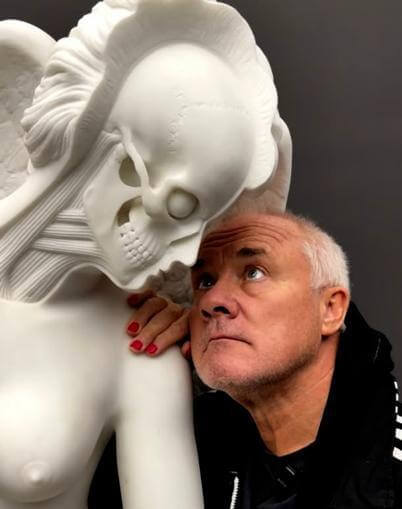
Photo credit: @damienhirst on Instagram

SUGGESTED CITATION
Srimadhbhagavatam, M., Williams, K., & Stroud, S. R. (September 2026). When Death Becomes Medium: Damien Hirst’s Use of Animal Remains in Art. Media Ethics Initiative, Center for Media Engagement. https://mediaengagement.org/research/when-death-becomes-medium/