



CASE STUDY
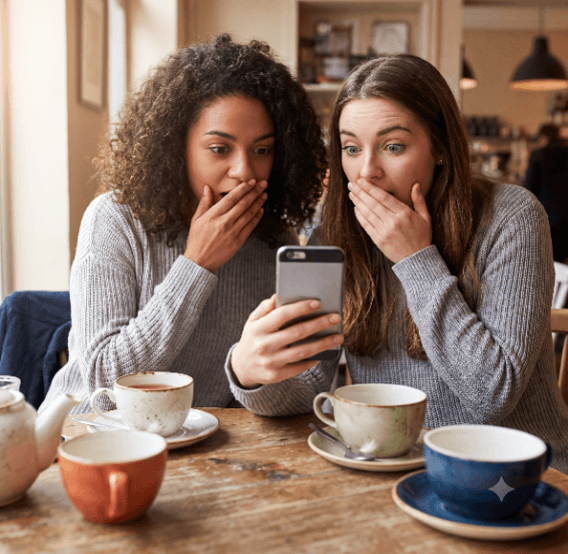
For decades, women have built “whisper networks”–both oral and, more recently, digital–to share information and warn one another about the men they date or encounter. Shared vulnerabilities, from physical safety to emotional manipulation, have fostered a culture of mutual protection and vigilance. In the digital age, especially in the wake of the #MeToo movement, this once informal exchange of “gossip” has evolved into online platforms like the Tea App, which allows women to remain anonymous while conducting background checks, viewing criminal records, reverse image searching, and sending or receiving tips about men.
To join the Tea App, women must first join a waitlist by submitting a selfie and photo ID–a measure taken to preserve the platform’s “women-only community”. After a waiting period that can range from a few days to a couple of weeks, approved users gain access to a database of men within a 100-mile radius. Similar to a dating app, the Tea App features a swipeable feed where each profile includes a photo, first name; and a list of red and green flags. Users can also leave comments, add new flags, and rate men based on their experiences or knowledge. For privacy reasons, searches can only be conducted by first name, nevertheless, women can conduct reverse image searches to uncover men’s criminal history or check for a sex offender status.
The Tea App is not the first example of women building online support systems. In the early 2000s, websites like WomenSavers.com and DontDateHimGirl.com emerged as digital spaces where women could expose cheating or abusive men (Cherelus, 2025). As social media evolved, so did these networks. Platforms such as “Are We Dating the Same Guy?” Facebook groups and “DatingTok” on TikTok have become even more public and widespread forms of spreading information. Before the digital era, these so-called “whisper networks” existed quietly, circulating by word of mouth and fading over time. Now, the move into online spaces has amplified their reach and permanence, transforming whisper networks into “scream networks” that could be used for potential harm rather than good (Wise, 2025).
Unfortunately, a system originally designed to promote mutual protection has, in some cases, devolved into a platform for public shaming and misinformation. The anonymity that once empowered women to share warnings in a safe and productive way has now enabled the widespread exchange of unverified accusations. This dynamic has sparked widespread concern for experts like University of Calgary Professor Emily Laidlaw, who claims these platforms “have the potential themselves to also be sources of harm” and promote “online mob behavior” (Wise, 2025). Men–including some not featured on the Tea App–have labeled the app as sexist, arguing the situation would receive greater backlash if it were a platform of men exposing women. The controversy has grown so significant that several defamation lawsuits have been filed against the app since its launch in 2023 (Wise, 2025). Additionally, opponents of the app have created their own adaptation of Tea, developing TeaOnHer, a platform allowing men to anonymously review and rate women.
The Tea App’s backlash does not end with concerned university professors, defamation lawsuits, or TeaOnHer. In July of 2025, the app was hacked, and over 70,000 ID photos and selfies were posted on an online message board called 4chan (Wakefield, 2025). Within moments, online misogynist groups got hold of these photos and built platforms for people to rank the women’s selfies, and created a leaderboard of the top 50 and bottom 50 photos. In addition to building these online games, people used the leaked information to create and post maps containing 33,000 pins throughout the United States. One woman–who wishes to remain anonymous for safety reasons–joined the app out of curiosity and deleted it shortly after as she found it too “gossip-y” (Wakefield, 2025). After the data breach, the woman got hold of the map that had been created and discovered her home was pinned (Wakefield, 2025). Although her name was not attached to the pin, the woman reported to BBC that she’s “very freaked out,” claiming that her stalker ex-boyfriend “didn’t know before where I lived or worked and I’ve gone to great lengths to keep it that way.”
Ultimately, a platform originally intended to help women navigate their unique vulnerabilities in the dating world has somewhat evolved into something more dangerous with the rise of the digital age. While many view platforms like the Tea App as a necessary safeguard for women’s safety, others argue that these platforms have become breeding grounds for misinformation and online shaming. Additionally, the harassment women received after the app’s data breach suggests that despite its effort to protect women, the Tea App might have hurt more women than it helped.
DISCUSSION QUESTIONS
-
What ethical values are in tension with apps such as Tea?
-
Is there a significant difference in the use of speech among those using the Tea App—and those such as TeaOnHer?
-
Could Tea App have been designed differently to preserve its protective function while reducing harm?
-
If the Tea App had required verified identity instead of anonymity, would it have solved the misinformation problem or just prevented more women from using it?
-
Can you design a short code of ethics for those posting on Tea App?
ADDITIONAL INFORMATION
About. Tea. (n.d.). https://www.teaforwomen.com/about
Cherelus, G. (2025). Women have always looked out for one another. it’s never been risk-free. New York Times.
Uwumarogie, V. (2025, August 12). I tried the tea app so you don’t have to-here’s what I found. Essence. https://www.essence.com/love/tea-dating-app/
Wise, A. (2025, August 2). Tea encouraged its users to spill. then the app’s data got leaked. NPR. https://www.npr.org/2025/08/02/nx-s1-5483886/tea-app-breach-hacked-whisper-networks
Wakefield, J. (2025, August 23). Tea app: I joined for safety. then my address was leaked and shared. BBC News. https://www.bbc.com/news/articles/ce87rer52k3o
ACKNOWLEDGMENTS
This case was supported by funding from the John S. and James L. Knight Foundation. It can be used in unmodified PDF form in classroom or educational settings. For use in publications such as textbooks and other publications, please contact the Center for Media Engagement at mediaengagement@austin.utexas.edu.
SUGGESTED CITATION
Dilger, M., & Stroud, S. R. (July, 2026). Sharing or shaming? The ethics of the tea app. Center for Media Engagement. https://mediaengagement.org/research/ethics-tea-app
Photo credit: Google Gemini