






SUMMARY
Building on research examining news coverage of contentious topics, the Center for Media Engagement explores how people across the political spectrum respond to different reporting styles: a solidarity approach, focused on people’s lived experiences, and a monitorial approach, centered on institutional authorities.
Participants appreciated the direct quotations and specific details in posts written with the solidarity approach, while monitorial-style posts were often seen as lacking context and human voices. Neither Democrats nor Republicans endorsed one approach over the other. Instead, members of both parties emphasized the importance of context, fairness, and complete information.
The findings suggest that combining the approaches may be an effective way to reach members of both parties. Reporters can strengthen coverage by keeping stories concise, pairing personal experiences with clear context and facts, and avoiding overreliance on officials as a presumed signal of neutrality.
BACKGROUND
News outlets often face challenges when covering contentious topics, such as protests and social justice issues, because they often spark emotional reactions among audiences. How journalists tell these stories is important because it can influence how people understand protests and how they perceive the role of protest as part of larger social movements in a democracy.1
The Center for Media Engagement (CME) previously tested various storytelling approaches for protest stories. When looking at stories that either humanize or criminalize the person whose death spurred a protest, we found that stories that humanize were perceived as more credible by Democrats, but less credible by Republicans. Another CME study found that an abortion protest story that utilized solidarity reporting — where journalists prioritize the firsthand knowledge, insights, and perspectives of people subjected to social injustice — was perceived as more credible to Democrats, compared to a “monitorial-style” story that amplified officials’ actions and comments. Republican readers’ perceptions of news credibility were unchanged regardless of which reporting approach was used.
Given the mixed results, this study delves more deeply into how people of different political affiliations respond to solidarity and monitorial reporting. We showed both Democrats and Republicans two news posts about protests on one of three topics: cuts by the Department of Government Efficiency (DOGE), Immigration and Customs Enforcement (ICE), and transgender rights.2 Half of the stories were written using a solidarity approach, focusing on protestors’ lived experiences, and half were written using a monitorial approach, centering on institutional authorities such as government officials and law enforcement.3
Examples of Story Posts
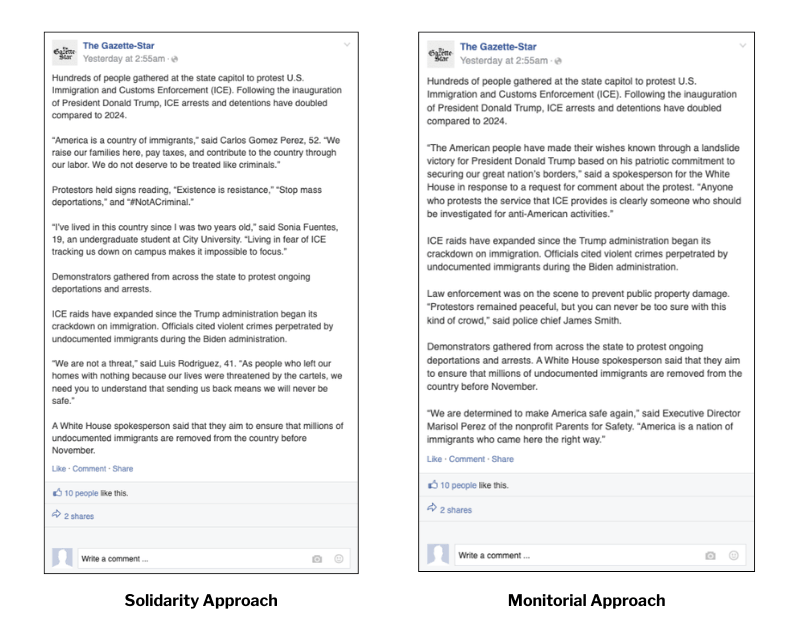 Our findings show participants appreciated the direct quotations and specific details in posts written with the solidarity approach, and they saw monitorial-style posts as lacking context and human voices. Neither Democrats nor Republicans endorsed one storytelling style exclusively; rather, members of both parties emphasized the importance of context, fairness, and complete information. Participants across partisan affiliations tended to positively evaluate solidarity posts because they provided accounts of what was happening on the ground. Republicans had mixed responses to what they perceived as emotional appeals from affected people in solidarity posts. Some considered this a valuable addition of a human touch, while others viewed it with skepticism and considered it a potentially manipulative tactic on the part of journalists. This is consistent with research on the limits of journalistic empathy — a feeling of walking in another’s shoes — and how it may backfire. In contrast, journalistic solidarity prioritizes the vantage point of affected people on the ground to hear the facts of their shared struggle.4
This research is part of our connective democracy initiative, funded by the John S. and James L. Knight Foundation. Connective democracy seeks to find practical solutions to the problem of divisiveness.
KEY FINDINGS
News posts written with the solidarity approach:
- Were perceived as more effective at explaining why protests were happening and what was at stake
- Were seen as more authentic, believable, and engaging because of direct quotes and specific details about protesters
News posts written with the monitorial approach:
- Were perceived as incomplete, lacking context and reasons for the protest
- Prompted more detached, analytical reactions
Differences and similarities between Democrats and Republicans:
- Both groups said good journalism should be balanced, avoid exaggeration, and contextualize the bigger picture, but they disagreed on what makes a story feel biased.
- Some Democrats considered monitorial reporting “propaganda,” while some Republicans called solidarity reporting “propaganda.”
- Democrats and Republicans both responded positively to including quotes from people who were protesting to understand why they were there.
- Both groups were skeptical when they noticed that the other side (counter-protestors, officials) was omitted from solidarity posts.
- Both groups were also skeptical of monitorial reporting when they noticed that the other side (protestors, affected people) was omitted from monitorial posts.
SUGGESTIONS FOR NEWSROOMS
- Combine solidarity reporting with monitorial reporting – while keeping the story succinct. Democrats and Republicans said they would have liked a story that combined the solidarity post and the monitorial post, without becoming too lengthy. Their main skepticism of news credibility arose from what they viewed as the oversimplification of complex issues. At the same time, participants did not think long-form reporting would work on social media, which points to the need for succinct storytelling that accounts for why these issues are contentious.
- Pair people’s stories with clear context and facts. Human voices help audiences understand why issues matter, but they are most effective when grounded in policy explanations and verified information.
- Avoid over-reliance on officials as a presumed signal of neutrality. Audiences do not automatically see authority-focused reporting as unbiased. If a story is about protests but begins by quoting a government official, audiences are skeptical of its credibility.
- Be mindful of tone and emotional cues. Emotion can deepen understanding for some readers and trigger skepticism for others, so framing should be deliberate, measured, and transparent.
- Adjust storytelling to the issue’s sensitivity. Topics tied to identity or personal harm require greater care in sourcing, language, and framing than more abstract policy debates.
- Use storytelling choices to support trust, not hype. Clear context, multiple perspectives, and authentic voices help build credibility and reduce the sense that news is sensational or agenda-driven.
FULL FINDINGS
Solidarity vs. Monitorial Storytelling
When participants discussed the solidarity news posts, they consistently described these stories as richer, more relatable, and fuller in context than monitorial posts. Many said solidarity-style storytelling helped them understand why people were protesting and what was at stake by highlighting personal experiences and the voices of those affected. As Cheesecake Baby,5 69, a Democrat, put it: “So that we can understand why they’re doing this … it’s important to interview the people as well, the protesters as well.” At the same time, Pocket, 42, a Republican, said: “I mean, it is important to hear why people are fearful. … It does still give you the emotion that these people are feeling.”
In contrast, monitorial posts were often described as authority-driven and lacking in important background, which made them feel incomplete or tilted toward institutional framing rather than lived experience. Regina, 59, a Democrat, explained: “Well, I think when they interview an authority figure like that over your average citizen who’s out there, it kind of frames this story in a certain way. What do the important people think? What does the guy in charge think? Instead of what do the people think?” Emily, 42, a Republican, said: “I think I get more of a robotic feeling from the [monitorial story]. Just that it lacks the depth and, like others were saying, context, and lacks that emotion where you just don’t really feel like you’re connecting to one side or the other.”
Participants overall tended to perceive solidarity posts as more trustworthy. Hearing directly from people affected by issues — rather than just learning what officials said — made the stakes feel more real and grounded. This alignment between human experience and credibility was echoed across all three protest topics (DOGE cuts, ICE raids, and transgender rights).
Emotional and Cognitive Engagement
Conversations about the two storytelling styles triggered different emotional responses. Discussions about solidarity posts were marked by stronger emotional reactions, such as anger, sadness, or concern, likely because these stories emphasized human suffering, injustice, or personal impact as the reasons for protests. Discussions about monitorial posts, on the other hand, prompted more analytical or evaluative reactions, eliciting emotions like surprise or anticipation when participants focused on institutional actions and political divisions in the United States.
These emotional differences matched the themes participants talked about: Solidarity narratives brought human stakes to the forefront, while monitorial narratives kept attention on procedures, reports, or conflict framing. Solidarity reporting was often described as more credible than monitorial reporting because quotes were primarily from on-the-ground protestors rather than from distanced officials or institutional sources. At the same time, participants said they would find the stories more credible if they included counter-protestors as well, whom participants believed were very likely present at the protests, though unmentioned in the posts.
Shared Expectations Across Political Lines
Democrats and Republicans agreed on some basic qualities of good journalism: News should offer a full picture, avoid exaggeration, and give clear explanations of why events matter. However, partisans interpreted emotional elements differently.
Democratic participants tended to see emotion and lived experience as explanatory assets that enhanced understanding and legitimacy. As Ariana, 33, explained: “Yes, I think it’s important to put what people have to say. … And I feel like putting their voice, you can see their suffering. You see everything they deal with.”
In contrast, Republican participants were more cautious, viewing reporting they perceived as emotionally charged as potentially subjective or agenda-driven if they felt it was not balanced with facts. Nicky, 56, explained: “Just propaganda news for clicks.”
Still, both groups criticized stories that seemed one-sided, and many Republicans acknowledged that personal narratives sometimes added important clarity. Overall, neither group endorsed one storytelling style exclusively; rather, both emphasized the importance of context, clarity, and complete information.
Topic-Specific Patterns and Propaganda Accusations
The policy topic itself shaped how people reacted to storytelling approaches. Discussions about ICE raids and trans rights protests were often more intense and critical overall. Ariana, a Democrat, 33, said she preferred the solidarity-style post regarding ICE. “It was a much more peaceful article,” she said. “The [monitorial story] just had threats. ‘If you think this or do that, you’re going to get investigated.’ Who knows what happens out of that?”
The word “propaganda” came up multiple times: Some Republicans responding to solidarity reporting about the DOGE protest called it “propaganda,” while Democrats did not. Some Democrats responding to monitorial reporting about the ICE protest called it “propaganda” and considered the solidarity reporting more credible, while some Republicans responding to solidarity reporting about the ICE protest called it “propaganda” and considered the monitorial reporting more credible. Both Republicans and Democrats responding to coverage of the protest for trans rights said that they thought the stories should be combined and asked, “Where’s the second half of the story?”
Participants seemed to scrutinize emotional language and selective quotes more closely in discussions about the ICE and trans rights protest post, compared to discussions about DOGE protests, which tended to feel more detached or procedural. As Republican Sierra, 35, explained regarding a solidarity post about trans rights protests: “This to me comes off like any regular news station would report on a story typically, which is neither right or wrong. Yeah, no. It’s just giving you the facts.”
News Credibility Diminishes Due to “The One-Sidedness of the Media as a Whole”
Across Democrats and Republicans, focus group participants repeatedly said that neither monitorial reporting nor solidarity reporting provided the full story. While news reporting training often emphasizes simplicity, participants said that the lack of complexity was suspicious and undermined news credibility. In the words of one Republican participant responding to the ICE stories, “The whole problem of both of these stories is we’re not getting a full story.” A Democrat participant echoed this criticism, also in response to the ICE stories, and said, “One side is humanized while the other side is not.” Participants also said they saw one-sided media coverage as typical and considered this a problem “of the media as a whole,” rather than unique to particular issues or protests.
METHODOLOGY
We recruited U.S. adults age 18 or older through Prolific, an online research platform that provides self-selected research participants for a fee. Participants completed an online survey distributed between July 29 and September 2, 2025, which received 528 valid responses.6 At the end of the survey, participants were asked whether they would be willing to take part in a follow-up focus group.
From those 267 participants who expressed interest, we selected participants to ensure balance across political affiliation and issue exposure. In total, 35 participants (19 Democrats and 16 Republicans) were invited and attended one of six online focus groups, held between August 18 and September 11, 2025. All participants provided informed consent prior to participation.7
Focus groups were conducted on Zoom and lasted an average of 57 minutes. Groups were separated by political affiliation to encourage open discussion. During each session, participants read two Facebook-style news posts about the same issue — one written in a solidarity style and one in a monitorial style —and discussed how the stories were written, how credible they felt, and how they compared.
Participants received $5 for completing the initial and follow-up surveys and a $25 e-gift card for participating in the focus group. All sessions were recorded with permission and professionally transcribed for analysis.
We analyzed focus group discussions to identify common themes in how people responded to different storytelling styles. In the experiment, we compared responses across storytelling approaches to examine how story framing influenced emotions, trust, and engagement. Together, these methods allowed us to capture both real conversations and measurable audience reactions. Analyses were conducted using both ChatGPT and qualitative analysis by a researcher.
Participant Demographics
| Survey
N = 482 |
Focus Groups
n = 35 |
|
| Gender | ||
| Women | 49.4% | 15 |
| Men | 50.4 | 19 |
| Nonbinary | 0.2 | 1 |
| Age | ||
| 18-29 | 15.6 | 4 |
| 30-49 | 48.5 | 15 |
| 50-64 | 28.0 | 13 |
| 65 and older | 7.9 | 3 |
| Hispanic, Latino, Latina | ||
| No | 90.9 | 32 |
| Yes | 9.1 | 3 |
| Race/Ethnicity | ||
| Asian/Pacific Islander | 5.8 | 3 |
| Black/African-American | 6.6 | 2 |
| Biracial/multiracial | 2.1 | 0 |
| Native American/Alaska Native | 0.6 | 0 |
| White/Caucasian | 83.4 | 28 |
| Other | 1.5 | 2 |
| Education | ||
| High school degree or less | 13.7 | 2 |
| Some college, trade school | 28.9 | 10 |
| Bachelor’s degree or more | 57.4 | 23 |
| Household Income | ||
| Less than $49,999 | 24.7 | 8 |
| $50,000 to $99,999 | 41.3 | 15 |
| $100,000 or more | 33.4 | 12 |
| Prefer not to respond | 0.6 | 0 |
| Political Beliefs | ||
| Democrat/Democrat-leaning | 40.9 | 19 |
| Republican/Republican-leaning | 59.1 | 16 |
Data from the Center for Media Engagement
- Chan, J. M., & Lee, C. C. (1984). The journalistic paradigm on civil protests: A case study of Hong Kong. In A. Arno & W. Dissanayake (Eds.), The news media in national and international conflict (pp. 183–202). Westview; Gitlin, (1980). The whole world is watching. University of California Press; McLeod, D. M., & Hertog, J. K. (1992). The manufacture of “public opinion” by reporters: Informal cues for public perceptions of protest groups. Discourse & Society, 3(3), 259–275. https://doi.org/10.1177/0957926592003003001; Shoemaker, P.J. (1982). The perceived legitimacy of deviant political groups: Two experiments in media effects. Communication Research, 9(2), 249-186; Harlow, S., & Kilgo, D. K. (2021). Protest news and Facebook engagement: How the hierarchy of social struggle is rebuilt on social media. Journalism & Mass Communication Quarterly, 10776990211017243; Kilgo, D. K., & Harlow, S. (2019). Protests, media coverage, and a hierarchy of social struggle. The International Journal of Press/Politics, 24(4), 508-530. https://doi.org/10.1177/1940161219853517.[↩]
- Recent news coverage illustrates that each of these topics has received sustained media attention. CBS News. (2025, April 5). “Hands off!” demonstrations protest Trump, Musk across U.S. CBS News. https://www.cbsnews. com/pictures/hands-off-americans-across-country-protest-trump-musk-doge-photos/; Santa, R., & Balsamo, M. (2026, February 3). Trump administration launches major immigration operation in Minnesota. The Associated Press. https://apnews.com/article/immigration-enforcement-ice-noem-minnesota-somali-db661df6de1131a03 4da2bda4bb3d817; Associated Press. (2025, December 18). Trump administration moves to cut off transgender care for children. AP News. https://apnews.com/article/trump-hhs-rfk-transgender-therapy-medicaid-64262c2 3cd1fb562a5d5e191d397014e.[↩]
- Varma, A. (2023). Solidarity reporting on marginalization: A grounded alternative to monitorial reporting’s emphasis on officials. Journalism Practice, 19(1), 186-202.[↩]
- Varma, A. (2020). Evoking empathy or enacting solidarity with marginalized communities: A case study of journalistic humanizing techniques in the San Francisco homeless project. Journalism Studies, 21(12), 1705-1723; Varma, A. (2019). When empathy is not enough: The possibilities for solidarity in the San Francisco homeless project. Journalism Practice, 13(1), 105-121.[↩]
- Pseudonyms that participants selected are used to identify them.[↩]
- To ensure we would recruit Democrats and Republicans equally, we set up quotas. Altogether, 267 participants indicated willingness to participate in a focus group by providing their emails (113 Democrats, 154 Republicans). A total of 256 participants were invited to participate in the focus groups (109 Democrats and 147 Republicans) after excluding people who may have taken the survey more than once, as evidenced by duplicate IP addresses (n = 5) or who failed at least one attention check (n = 6). Of those, 35 people ultimately attended the focus groups, 19 Democrats and 16 Republicans.[↩]
- The University of Texas at Austin’s Institutional Review Board approved this project on July 29, 2025.[↩]