



CASE STUDY
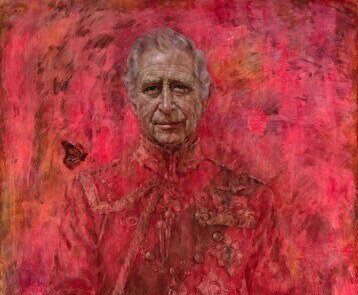
For millennia, royal portraits have shaped public perceptions of the monarchy. From Hyacinthe Rigaud’s Portrait of Louis XIV (1701), which captured the French king’s idealized image, to Thomas Sully’s Portrait of Queen Victoria (1838), depicting her accession to the throne, these works have served as symbols of power and prestige. While traditional royal portraits have emphasized elaborate displays of wealth, contemporary portrayals use stylized and subtle symbolic elements to convey the subject’s character and authority. The first official portrait of King Charles III since his coronation, painted by British artist Jonathan Yeo, depicts the king in the uniform of the Welsh Guards and positioned against a dramatic red background that immediately grabs the viewer’s attention. Unveiled at Buckingham Palace on May 14, 2024, the 8.5-by-6.5-foot portrait drew immediate media attention for its artistic style, debated symbolism, and the evolving role of art in shaping public perception of the monarchy.
Yeo’s painting depicts King Charles III holding a sword while standing in a frontal pose, a stance historically associated with authority and stability in royal portraiture. Unlike traditional portraits that highlight material wealth, Yeo includes the symbolic element of a butterfly near the king’s right shoulder. The painting’s vivid red background has generated the most controversy, with many finding it overwhelming or unnecessary due to its ambiguous meaning. In a statement released by Buckingham Palace, Yeo explained his goal was to “reference the traditions of royal portraiture but in a way that reflects a 21st-century monarchy and, above all else, to communicate the subject’s deep humanity” (Choi, 2024). While Yeo’s artistic decisions were intended to modernize and humanize the portrait, they have also received criticism, with some arguing that these choices fuel controversy over the subject’s character and legacy. The portrait raises important ethical questions about artistic freedom and responsibility: To what extent should artists balance artistic expression with accuracy when portraying their subjects, and where should the boundary between interpretation and representation be set?
The reveal of the royal portrait generated widespread criticism on social media. Negative comments quickly spread on Instagram, where the royal family posted the official image. One user wrote: “To me it gives the message the monarchy is going up in flames or the king is burning in hell” (@theroyalfamily on Instagram, 2024). Others compared the red background to blood, the devil, or referenced the nation’s contested history by mentioning “colonial bloodshed” (@theroyalfamily on Instagram, 2024). Art critics have also questioned the symbolic efficiency of the portrait. Sebastian Smee, an art critic at the Washington Post, argued that the painting is full of artistic contradictions that fail to support the intended symbolism, describing Yeo’s method as “flattery and facility with a sprinkling of symbolism amid splashes of color. Here, the result is loud and lurid (that shimmering, psychedelic crimson almost swallows up the poor monarch). But aesthetically, it’s very weak tea” (Smee, 2024). Opponents of the portrait claim Yeo’s artistic choices are ambiguous and unsettling, overshadowing the traditional purpose of a royal portrait. Many argue that the depiction has led to misinterpretation regarding King Charles III’s legacy and character. Rather than preserving the monarch’s image, critics contend that the portrait undermines the subject and raises ethical concerns about whether royal portraits should incorporate heavily stylized elements.
Defenders of Yeo’s portrait argue that artists should have the freedom to depict royal subjects in stylized and modernized ways, as long as the subject agrees with the depiction. Yeo has stated that the king was involved in the decision-making process for the portrait, including suggesting the butterfly as a symbol of both rebirth and his environmental advocacy (Razzall, 2024). Yeo aimed to create a contemporary portrayal of the monarch, stating that the portrait “reflects exactly who he is, everything he represents and what he’s been through” (Razzall, 2024). In addition to the king’s approval, Queen Camilla reportedly told Yeo, “you’ve got him,” referring to the likeness he achieved. Some have argued that Yeo’s artistic choices reflect the evolving role of art in society. Grand Élan, an online magazine, described the portrait as a “powerful, red-drenched work [that] confronts the public, demanding a reaction and forcing a dialogue about the future of the monarchy” (Grand Élan, 2025). Historically, royal portraits primarily documented the monarch in a posed and idealized way to convey authority, leaving little room for alternative interpretations. As societal beliefs and artistic practices have evolved, many argue that restricting artists to traditional depictions limits the value and appreciation of art. Yeo’s symbolism invites viewers to reconsider what a monarch represents today. Supporters have maintained that the portrait does not intentionally misrepresent its subject; instead, the portrait offers a humanized portrayal of the king without diminishing his authority. Since varying public reactions are inevitable, proponents claim that artistic freedom in royal portraiture is ethically justified and essential for encouraging modern perspectives.
Contemporary royal portraits, such as Yeo’s depiction of King Charles III, offer a more humanized and modern perspective on the monarchy. However, by relying on ambiguous symbolism and abstract elements, they also risk misrepresenting a subject or a nation’s history, raising a central question: To what extent should artists prioritize artistic expression in official royal portraits when their choices may negatively impact public perceptions of the subject’s character and legacy?
DISCUSSION QUESTIONS
- What are the ethical concerns of an artist prioritizing abstract, artistic elements and ambiguous symbolism in an official royal portrait?
- What is the role of an artist when creating an artwork of an influential figure in history? How faithful should these portraits stay to the original image of the subject?
- How does the historical purpose of royal portraiture affect this work’s ethical responsibility to represent the societal values of its time? How does Yeo’s portrait represent the changing status and responsibility of art in modern times?
ADDITIONAL INFORMATION
- Choi, Christy. “King Charles’ first official portrait since coronation proves divisive.” CNN, May 15, 2024. Available at: https://www.cnn.com/2024/05/15/style/king-charles-first-portrait-since-coronation-unveiled/index.html
- Friedman, Vanessa. “A Shock of Red for a Royal Portrait.” The New York Times, May 15, 2024. Available at: https://www.nytimes.com/2024/05/15/style/king-charles-iii-portrait-jonathan-yeo-red.html
- Grand Élan. “The Sanguine Reign: Jonathan Yeo’s Radical Portrait of King Charles III.” October 12, 2025. Available at: https://ge-magazine.com/the-sanguine-reign-jonathan-yeos-radical-portrait-of-king-charles-iii/
- Razzall, Katie. “King Charles: First official portrait since coronation is unveiled, painted by Jonathan Yeo.” BBC News, May 14, 2024. Available at: https://www.bbc.com/news/entertainment-arts-68981200
- Smee, Sebastian. “King Charles III’s blood-red portrait is a stylistic mess.” The Washington Post, May 15, 2024. Available at: https://www.washingtonpost.com/entertainment/art/2024/05/15/king-charles-portrait/
- @theroyalfamily. Instagram Post. “The King today unveiled a new portrait by @jonathanyeo at Buckingham Palace.” May 14, 2024. Available at: https://www.instagram.com/p/C68_S5iMWZg/
ACKNOWLEDGMENTS
This case was supported by funding from the John S. and James L. Knight Foundation. It can be used in unmodified PDF form in classroom or educational settings. For use in publications such as textbooks, readers, and other works, please contact the Center for Media Engagement at mediaengagement@austin.utexas.edu.

SUGGESTED CITATION
Paoli, A., Williams, K., & Stroud, S. R. (November 2026). Tradition, Image, and Artistic Expression: The Ethics of Representation in Royal Portraits. Media Ethics Initiative, Center for Media Engagement. https://mediaengagement.org/research/representation-in-royal-portraits
Photo credit: https://www.jonathanyeo.com/king-charles-iii