



CASE STUDY
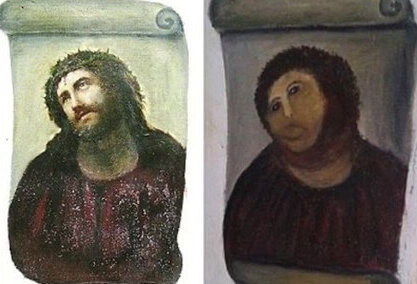
If art is meant for everyone to appreciate, does that mean anyone should have the right to restore it? In the Sanctuary of Mercy church in Borja, Spain, the fresco Ecce Homo by Spanish painter Elías García Martínez has adorned the walls for decades. Painted around 1930, Martínez’s artwork gained international attention in 2012 after a failed restoration attempt. The amateur restoration by Cecilia Giménez dramatically altered Martínez’s depiction of Jesus Christ, obscuring its original artistic features and turning it into an internet sensation. Side-by-side images of the original fresco and the restoration—quickly nicknamed “Monkey Christ” and “Potato Jesus”—went viral online, inspiring numerous memes and merchandise.
Motivated by concern for the fresco’s fading condition, Giménez took the initiative to restore the work herself. However, before she could complete the restoration, images of her progress spread online, and Giménez faced severe criticism for causing irreversible damage. This event sparked debate, as many argued that Giménez lacked the professional and artistic skills necessary for restoring a work with significant communal, historical, and religious significance. However, her restoration also unexpectedly bolstered Borja’s local economy, as tourist numbers grew in the region. This incident underscores ethical questions about who should be authorized to restore culturally significant art and how society should weigh the risks of amateur intervention against the consequences of neglect.
The main goal of art restoration is to return the artwork or artifact to its original condition. Most viewers would agree that Giménez’s restoration appears strikingly different from the original. Residents of Borja and news reporters questioned how Giménez was permitted to proceed in the first place. Giménez insisted that she had received permission from the local priest after noticing the fresco’s neglected condition. She emphasized that she worked openly inside the church, where church members could see her ongoing progress. Nevertheless, critics maintained that informal approval did not justify altering the fresco. Trained conservators and restorers have also argued for more regulated restoration rules. For instance, Ana Galán Pérez, the chair of Spain’s Professional Association of Restorers and Conservators (Acre), maintains that “every time someone without the right qualifications tries to restore a work, they run the risk of damaging or even destroying it” (Jones, 2018). Opponents of the intervention claim that poor restorations damage cultural history and should not be attempted by amateurs without proper training and technique, even if they have positive intentions.
According to El Heraldo de Aragón, a local newspaper in the province of Zaragoza, the family members of the original painter have expressed their dissatisfaction with Giménez’s work (Jones, 2012). This underscores the argument that only well-trained professionals should be entrusted with restoring valuable artworks. Unqualified restorations risk irreversible damage to the integrity of the original creation. Given this, critics have argued that stricter regulations for restoration are necessary to protect artistic heritage from ruin. Additionally, critics have noted the poor aesthetic quality of the restoration. BBC Europe correspondent Christian Fraser remarked that the fresco’s current state resembled “a crayon sketch of a very hairy monkey in an ill-fitting tunic” (BBC News, 2012). Despite Giménez’s claims of the permission she received, many argue that the painting should have been left untouched in its faded condition.
Despite this criticism, the outcome of Giménez’s restoration was not entirely negative. After images of the restoration went viral, thousands of tourists visited Borja, providing a major boost to the local economy. The restoration attracted over 150,000 visitors from around the world, with each paying a one-euro entry fee to see the new fresco. This unexpected surge in tourism generated both visibility and revenue for the town. Opera librettist Andrew Flack, who traveled to Borja to view the restoration, described the event as a “miracle that has boosted tourism” (Carvajal, 2014). Local businesses benefited from the increase in visitors, and the incident created a surge in patronage for local restaurants and museums. For example, the nearby Museum of Colegiata “experienced a rise in annual visits to 70,000 from 7,000 for its religious, medieval art” (Carvajal, 2014). Supporters of the restoration argue that Borja has gained global recognition, and Giménez’s work has benefited both the town’s economy and the appreciation for Spanish art from the region. Proponents also claim that the restoration was an act of devotion to a neglected painting, suggesting that without her intervention, the fresco might have completely faded over time. Her personal commitment brought renewed attention to the artwork and inspired others to value cultural heritage in new ways. The incident even generated creative responses, such as merchandise and children’s art competitions. Art critic Jonathon Keats asserts that Giménez’s restoration is “an intensely personal expression of religious faith,” suggesting that her efforts have inspired a deeper public engagement with art and faith (Keats, 2012).
The amateur restoration of Ecce Homo highlights the risks of untrained restoration but also shows how public reaction can redefine a work of art. This case has generated ongoing debate about artistic authority and preservation, leaving a central question for the art world: Who has the right to restore art when well-intentioned action risks irreversible damage?
DISCUSSION QUESTIONS
- What are the ethical issues with prioritizing “good intentions” over artistic integrity? Does Cecilia Giménez’s desire to save the decaying fresco provide a moral defense for her actions?
- What are the ethical concerns regarding the absence of formal restoration regulations vs. the potential neglect of cultural heritage works?
- Who holds the ultimate ethical authority over religious and public artwork—the artist and their descendants, the church, the public, someone else?
- Is it ethically justifiable to celebrate a failed restoration for its economic success?
ADDITIONAL INFORMATION
- BBC News. “Woman who ruined Spanish fresco ‘had permission’ from priest.” BBC News, August 23, 2012. Available at: https://www.bbc.com/news/av/world-europe-19358072
- Carvajal, Doreen. “A Town, if Not a Painting, Is Restored.” The New York Times, December 14, 2014. Available at: https://www.nytimes.com/2014/12/15/world/a-town-if-not-a-painting-is-restored.html
- Jones, Sam. “Experts call for regulation after latest botched art restoration in Spain.” The Guardian, June 22, 2020. Available at: https://www.theguardian.com/artanddesign/2020/jun/22/experts-call-for-regulation-after-latest-botched-art-restoration-in-spain
- Jones, Sam. “How ‘Monkey Christ’ brought new life to a quiet Spanish town.” The Guardian, December 28, 2018. Available at: https://www.theguardian.com/world/2018/dec/28/how-monkey-christ-brought-new-life-to-a-quiet-spanish-town
- Jones, Sam. “Spanish church mural ruined by well-intentioned restorer.” The Guardian, August 22, 2012. Available at: https://www.theguardian.com/artanddesign/2012/aug/22/spain-church-mural-ruin-restoration
ACKNOWLEDGMENTS
This case was supported by funding from the John S. and James L. Knight Foundation. It can be used in unmodified PDF form in classroom or educational settings. For use in publications such as textbooks, readers, and other works, please contact the Center for Media Engagement at mediaengagement@austin.utexas.edu.

SUGGESTED CITATION
Paoli, A., Williams, K., & Stroud, S. R. (November 2026). Restoration or Reinvention? The Ethics of Art Restoration. Media Ethics Initiative, Center for Media Engagement. https://mediaengagement.org/research/art-restoration
Photo credit: https://www.flickr.com/photos/joanjo_aguar_matoses/8492072752/in/photostream/