




SUMMARY
Perceptions that the news media are biased can shape how audiences interpret political events, judge news organizations, and view people with opposing political beliefs. Partisan, emotional, moralizing, and toxic language may make coverage appear less neutral, intensify disagreement, and reduce trust in journalism.
The Center for Media Engagement examined how news organizations could use generative artificial intelligence, such as ChatGPT, to rewrite news posts to reduce biased or inflammatory language while preserving the core information. We found that people perceived the AI-rewritten posts as less biased and toxic than the originals, although the rewritten posts were not seen as more credible. We also found that the AI-rewritten posts contained fewer instances of language that expressed opinions as facts or depicted people, actions, and events in terms of right or wrong.
These findings suggest that news organizations could use AI as an editing tool to identify and revise wording that may be perceived as biased or inflammatory, while maintaining human review to protect accuracy, context, and editorial judgment.
THE PROBLEM
Public perception that some news media are biased is a persistent concern for newsrooms. Audiences often judge bias through reporting choices, such as story framing, source selection, missing context, and political slant, which can shape whether they see a story as fair and credible.1 News consumers worldwide report that the perception that the media are biased is a major reason they question journalism’s integrity and credibility. When people see coverage as biased or one-sided, it can weaken how credible they find both the story and the news organization.2
The Center for Media Engagement’s research examines how journalists can address this problem by revising news posts to use more neutral language while preserving key facts.
This research is part of our connective democracy initiative, funded by the John S. and James L. Knight Foundation. Connective democracy seeks to find practical solutions to the problem of divisiveness.
KEY FINDINGS
- Participants viewed AI-revised posts as less biased than the originals. Participants rated original posts as slightly biased toward liberals, while they rated AI-revised posts as closer to neutral.
- AI edits did not make the posts seem more credible, make readers feel fewer negative emotions, or improve their views of the news outlet.
- AI-revised posts did not reduce partisan feelings — that is, how warmly or negatively people felt toward those who disagree with them politically.
- AI-revised posts contained slightly less subjective language than the original posts, particularly when they came from news outlets with a predominantly right-leaning audience.
- AI revision did not reduce emotional language overall, but it changed the emotional tone by increasing positive and trust-related language while reducing several other types of emotional language.
- AI-revised posts used less moralizing language — meaning words and phrases that frame people, actions, or events in terms of right and wrong, fairness, authority, care, and purity.
- AI revision substantially reduced toxic language, including insults, threats, and identity-based attacks, in posts from sources with both predominantly left- and right-leaning audiences.
- Participants were more likely to recognize when AI had been used when the post included a clear label.
IMPLICATIONS
- News organizations could use AI as an editing tool to reduce subjective, moralizing, or toxic language — that may convey bias to their audience — before publication, particularly in politically sensitive stories.
- AI revision may help news stories appear less biased to readers, but it should not be expected to improve credibility, reduce negative emotions, or change broader partisan attitudes.
- Newsrooms should maintain human oversight and clearly disclose meaningful AI involvement because transparency helps audiences recognize when AI has been used.
FULL FINDINGS
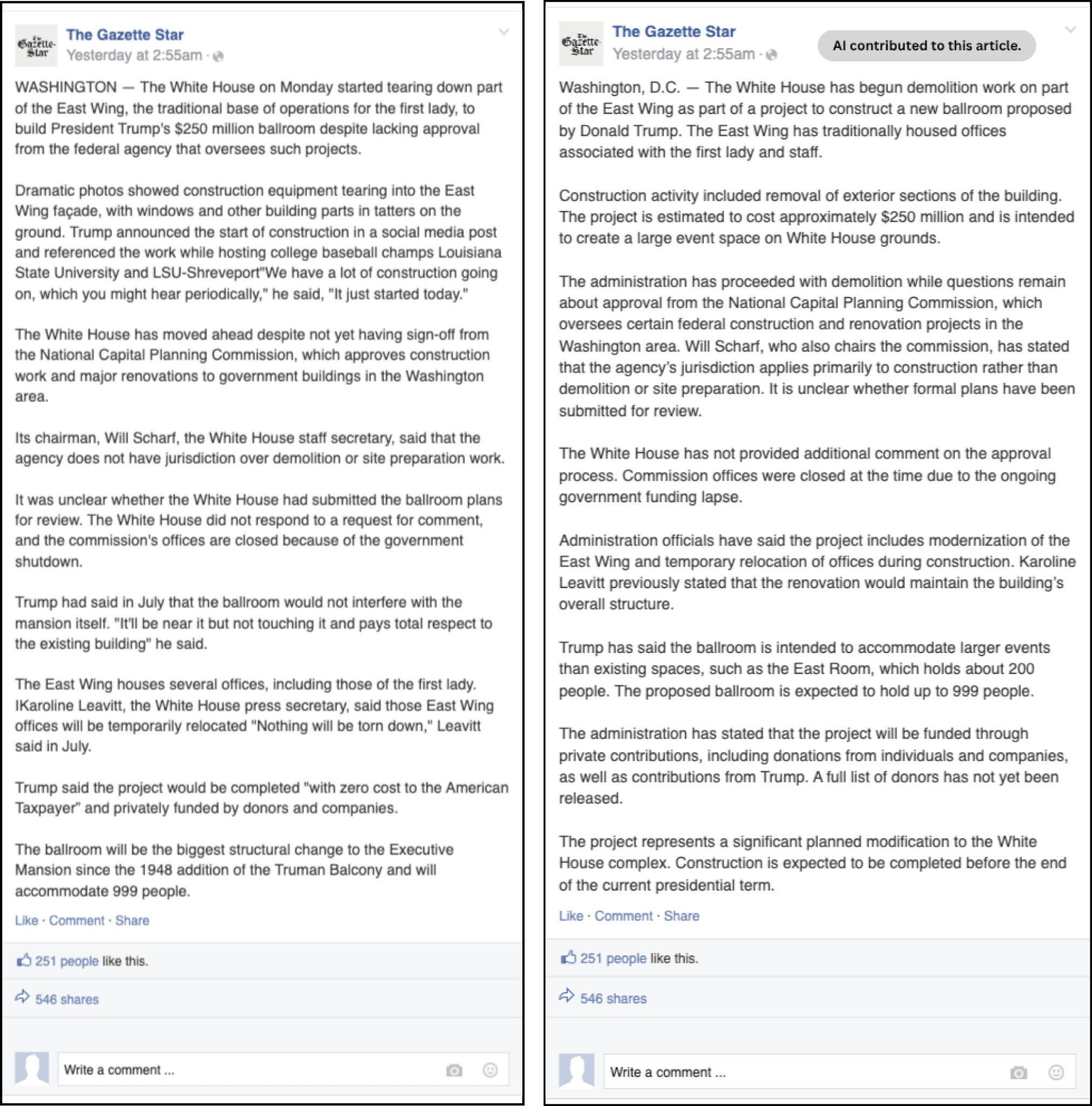
Participants were shown a Facebook post from a news outlet about one of two news topics (ICE raids or Trump’s new ballroom). The posts were either an original story from a news outlet with a predominantly right-leaning or left-leaning audience, or an AI-rewrite of the post. The AI-rewritten posts were labeled as such. After viewing the posts, participants were asked questions about them.
Participants perceived AI-revised posts as less biased than originals, but the AI-revised posts were seen as equally credible as the originals.3
The AI-revised stories were perceived as more neutral, while original stories were perceived as slightly slanted more toward the left.4 This finding suggests that revising partisan or emotionally charged wording can make news coverage appear more neutral to audiences.5
AI revision did not improve readers’ attitudes toward the news organization that published the post. Readers were not more likely to find the outlet engaging or express greater interest in reading or sharing its content.6
Exposure to AI-revised stories did not reduce negative feelings toward members of an opposing political group or strengthen positive feelings toward members of one’s own group.
Participants exposed to AI-revised stories did not report lower levels of negative emotion than readers exposed to original stories. Although the wording of the posts changed, these changes did not noticeably reduce readers’ feelings of anger, anxiety, fear, unease, or other negative emotions.7
Participants were more likely to recognize when AI had been used when the post included a clear label.8
AI Rewrites
We asked AI to rewrite 100 news posts and then compared the language in the revised versions to the original versions.
We found that the AI-revised stories included much less toxic content, such as insults and threats, than the original stories. This was the case across all posts, regardless of whether they came from outlets with left- or right-leaning audiences.9
The AI-revised posts also contained substantially less language that presented people, actions, or events in moral terms. Both morally approving and morally condemning language, such as language related to fairness and authority, appeared less frequently in the rewrites, compared to the original stories.10
The AI-revised posts did not contain less emotional language overall or less negative emotional language. Rather, the emotional tone shifted. The revised stories included more positive and trust-related language, while using less language associated with disgust, joy, sadness, and surprise compared to the original stories.11
The AI-revised posts used slightly less subjective language than the original posts, providing limited support for the expectation that AI revision would make news writing more neutral. The reduction varied by topic and was more apparent in posts that had originally come from news outlets with a right-leaning audience than those with a left-leaning audience.12
METHODOLOGY
Participants were recruited through Prolific, an online platform that connects researchers with people who choose to take part in paid studies. Participants had to be U.S. residents who were at least 18 years old, and we used political quotas to recruit roughly equal numbers of Democrats and Republicans. The sample was not randomly drawn from the U.S. population and should not be considered nationally representative. Participants received $1.50 for completing the study, which took 9.54 minutes on average.
After consenting,13 participants (N = 993)14 were randomly assigned to view one of eight mock Facebook posts about politics. For each of two topics (ICE raids and Trump’s ballroom), participants saw one of four posts: an original article from an outlet with a left-leaning audience, an original article from an outlet with a right-leaning audience, or AI-revised versions of each. All posts appeared to come from The Gazette Star, a fictional news outlet created for the study, to reduce the chance that participants’ responses would be shaped by their existing perceptions of bias toward a real news outlet rather than by the content and wording of the posts.15
We collected 100 news posts covering 10 widely discussed topics at the time: the Iran war, artificial intelligence, redistricting battles before the midterm elections, the Jeffrey Epstein files,16 Trump’s appearance at an NBA Finals game, the World Cup, ICE raids, the Department of Homeland Security shutdown, Kristi Noem’s removal as Secretary of Homeland Security, and Trump’s demolition of the White House East Wing and plan to build a large ballroom. For each topic, we selected five posts from outlets with predominantly left-leaning audiences (The New York Times, the BBC, and The Guardian) and five from outlets with predominantly right-leaning audiences (Fox News, The Wall Street Journal, and Newsmax). We varied the sources to ensure we were considering a wide range of editorial approaches.
We asked ChatGPT-5.5 to rewrite each article using the instruction, “Rewrite so that it removes any bias from left or right. Make it around 300 words,” producing 100 revised posts of similar length. We then compared each original article with its AI-revised version using established language tools to measure subjectivity, emotional language, and moral language, while an additional AI-based review assessed toxicity, including insults, threats, and identity-based attacks. We also examined whether the effects of AI revision differed depending on the news topic or whether the original article came from an outlet with a left-leaning or right-leaning audience.
Participant Demographics
| n = 993 | |
| Gender | |
| Women | 45.4% |
| Men | 54.0 |
| Nonbinary | 0.6 |
| Age | |
| 18-29 | 23.0 |
| 30-49 | 47.4 |
| 50-64 | 21.8 |
| 65 and older | 7.9 |
| Hispanic, Latino, Latina, Latinx | |
| No | 91 |
| Yes | 9.0 |
| Race/Ethnicity | |
| Asian/Pacific Islander | 4.9 |
| Black/African-American | 15.7 |
| White/Caucasian | 74.7 |
| Native American/Alaska Native | 0.6 |
| Other/Multiracial | 3.6 |
| Prefer not to respond | 0.4 |
| Education | |
| High school degree or less | 14.1 |
| Some college; trade school | 27.3 |
| Bachelor’s degree or higher | 58.6 |
| Household Income | |
| Less than $49,999 | 28.1 |
| $50,000 to $99,999 | 40.6 |
| $100,000 or more | 31.3 |
| Political Beliefs | |
| Democrat/Democrat-leaning | 51.4 |
| Republican/Republican-leaning | 48.6 |
Data from the Center for Media Engagement
- Lewis, S. C., Mathews, N., & Bunquin, J. B. A. (2026). Folk theories of news bias: How audiences perceive, interpret, and experience it. Journalism Studies, 27(7), 1031-1050. https://doi.org/10.1080/1461670X.2026.2615722; Masullo, G. M., & Yao, S. (2026). Quotes and credibility: How news post approach shapes news bias and credibility perceptions across party lines. News Research Journal. Advance online publication. https://doi.org/10.1177/30497841261440467[↩]
- Reuters Institute for the Study of Journalism. (2026). Overview and key findings of the 2026 Digital News Report. Reuters Institute for the Study of Journalism. https://reutersinstitute.politics.ox.ac.uk/digital-news-report/2026/dnr-executive-summary; Yao, S., Masullo, G. M., Varma, A., & Limov, B. (2026, July 1). Combining reporting styles can help reporters cover contentious topics. Center for Media Engagement. https://mediaengagement.org/research/combining-reporting-styles/[↩]
- This was tested using an analysis of covariance (ANCOVA) with AI rewrite condition, topic, and political like-mindedness as independent variables, perceived credibility as the dependent variable, and two covariates: four items (e.g., Use of AI to rewrite news posts without a human journalist reviewing them) regarding attitudes toward AI on a scale of 1 (completely unacceptable) to 7 (completely acceptable) [M = 2.70, SD = .91] and prior familiarity with the news post topic on a scale of 1 (not at all familiar) to 7 (very familiar) [M = 3.57, SD = 1.98]. Credibility perception was measured using a scale adapted from Appelman, A., & Sundar, S.S. (2016). Measuring message credibility: Construction and validation of an exclusive scale. Journalism & Mass Communication Quarterly, 93(1), 59-79. https://doi.org/10.1177/1077699015606057. Participants rated how “accurate,” “authentic,” “believable,” and “trustworthy” the news post was on a scale of 1 (describes it very poorly) to 7 (describes it extremely well), and the responses were averaged together with high reliability, M = 5.00, SD = 1.21, α = .93.[↩]
- Direction of bias was measured by a single question where participants rated on a scale from 1 (biased toward liberals) to 7 (biased toward conservatives) the direction of bias they perceived in the post they viewed [M = 3.94, SD = 1.21]. This was tested using an ANCOVA, which showed a significant main effect of AI rewrite, F(1, 974) = 10.29, p = .001, ηp² = .010. Participants rated AI-revised stories higher on the bias-direction scale (M = 4.06, SE = 0.06) than original stories (M = 3.81, SE = 0.06)[↩]
- [1] Perception of news post bias was measured by a single question where participants rated on a scale from 1 (not at all biased) to 7 (very biased) the level of bias they perceived in the post they viewed [M = 3.77, SD = 1.56]. This was tested using the same analysis of covariance (ANCOVA) model explained in endnote 7.[↩]
- Attitudes towards news outlets were measured using a scale from Masullo, G.M., Riedl, M.J., & Huang, Q.E. (2022). Engagement moderation: What journalists should say to improve online discussions. Journalism Practice, 16(4), 738-754. https://doi.org/10.1080/17512786.2020.1808858. Participants rated five items regarding their attitudes towards news outlets (e.g., This news outlet offers engaging content) on a scale of 1 (strongly disagree) to 7 (strongly agree), and the responses were averaged together with high reliability, M = 4.29, SD = 1.24, α = 0.90.[↩]
- We assessed negative emotions using a series of adjectives from Watson, D., Clark, L.E., and Tellegen, A. (1998). Development and validation of brief measures of positive and negative affect: The PANAS scales. Journal of Personality and Social Psychology, 54(6), 1063–1070. https://doi.org/10.1037/0022-3514.54.6.1063 and Dillard, J. P., & Peck, E. (2000). Affect and persuasion: Emotional responses to public service announcements. Communication Research, 27(4), 461-495. https://doi.org/10.1177/009365000027004003. Participants rated eight negative emotions (e.g., upset, hostile, ashamed) on a scale of 1 (not at all) to 7 (very much), and the responses were averaged together with high reliability, M = 2.51, SD = 1.48, α = 0.93.[↩]
- AI use detection was measured by a single question asking participants what percentage of the words in the article they thought were rewritten by an AI editor, rather than by a human journalist from a slide 0-100 [M = 48.96, SD = 26.12].[↩]
- Toxic content was assessed using ChatGPT 5.5 to code each article on a 0–4 scale for toxicity — defined as rude, disrespectful, or unreasonable language — as well as insults, threats, and identity attacks. Scores were averaged to form a composite index, and reduction scores were calculated as original minus AI-revised scores, such that positive values indicate less toxic content after revision.[↩]
- Moral language was measured using the Moral Foundations Dictionary 2.0 as the number of words associated with five foundations — care/harm, fairness/cheating, loyalty/betrayal, authority/subversion, and purity/degradation — per 100 words. Reduction scores were calculated as original minus AI-revised scores, such that positive values indicate less moral language after revision.[↩]
- Emotional language was measured using the NRC Emotion Lexicon as the number of words associated with at least one of eight emotions — anger, anticipation, disgust, fear, joy, sadness, surprise, and trust — per 100 words. Reduction scores were calculated as original minus AI-revised scores, such that negative values indicate more emotional language after revision.[↩]
- Subjectivity was measured using the MPQA Subjectivity Lexicon as the number of subjective clues per 100 words. Reduction scores were calculated as original minus AI-revised scores, such that positive values indicate lower subjectivity after revision.[↩]
- The Institutional Review Board at The University of Texas at Austin approved the project on June 15, 2026.[↩]
- Initially, 1,040 people started the experiment but data were not analyzed for those who may have taken the survey more than once, as evidenced by a duplicate IP address (n = 10), were not 18 years or older (n = 2), failed at least two of the three attention checks (n = 4), finished the survey too slowly (n = 18), could not see the news post (n = 9), and did not read the news post (n = 4). This resulted in N = 993.[↩]
- Masullo, G. M., & Yao, S. (2026). Quotes and credibility: How news post approach shapes news bias and credibility perceptions across party lines. News Research Journal, 47(3), 296-320. https://doi.org/10.1177/30497841261440467[↩]
- Massive collection of millions of government documents, images, and videos detailing the sex-trafficking operations of the late financier.[↩]