




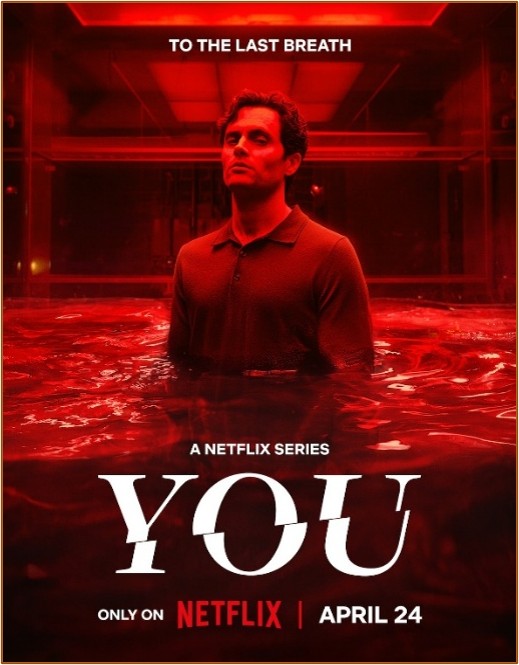
On September 9, 2018, the television show You was released and took audiences by storm as many viewers took a strong liking to the main character played by Penn Badgley. The show follows the fictional love life of a man named Joe Goldberg – a handsome and seemingly normal guy. In his relationships, he is romantic, caring to a fault, charming, thoughtful, and kind; however, he has killed almost every woman he’s been in a relationship with and demonstrated extremely toxic, manipulative, and dangerous behavior when interested and associated with women. Examples of this behavior include kidnapping and locking his love interests in a glass cage he built in his basement, killing the close friends of his love interests to become closer to them, stalking women to such an extreme extent that he would break into their houses to collect intimate, personal items, and lastly, killing the women when he eventually lost interest.
While this show has been running for four seasons and is on track for a fifth, You has been subject to controversy over the show’s glamorization of stalking and male violence against women, as well as, the impacts Joe Goldberg’s character has made on the show’s audience. Despite You graphically showing Joe brutally torturing, kidnapping, and murdering whomever it takes, including his love interests, to find the person he is meant to be with, many watchers and fans of the television show have gone to social media platforms to announce their love for and attraction to the toxic character. Tweets like “@pennbadgley kidnap me pls” tweeted by @Malikaplays, “need a joe goldberg bf” by @elisaroura, and “Y’all can never make me hate Joe Goldberg” by @vxmachina, highlight the very unhealthy and dangerous affection some viewers have towards this troubled character and his abusive tendencies.
The big question is why are so many people attracted to Joe Goldberg? Many critics have blamed Netflix, the show’s current owner, for giving Joe too much charm, and even the cast of the show agrees. According to an interview on Entertainment Tonight with Penn Badgley, the actor who plays Joe Goldberg, Badgley points the blame on Netflix saying “With our show, you’re meant to fall in love with [Joe Goldberg], that’s on us” (Ng, 2023). The character’s ability to pass off psychopathic narcissism and stalkerish obsessions as romantic sensitivity makes Joe’s evil actions easy to pass off and his character impossible not to root for (Hale, 2019). Joe’s internal monologue that has been present throughout the entirety of the show does not help the problem either as it allows for him to reason his horrible actions with the audience. This idea of You watchers not hating Joe’s toxic actions but being attracted to them supports a dangerous trend of women and men being influenced by the media’s increased portrayal of domestic violence on women which has caused society to more easily accept attitudes favoring violence against women (Gavin & Kruis, 2022). This increasing societal acceptance of domestic violence, caused by shows like You, gives more reason for both men to be violent against women, as well as women to accept violence from men more easily – causing some worry. While there is much concern over the show’s glamorization of domestic violence, obsession, and stalking, Netflix does have its reasons for writing and filming You the way it is. In an interview with the HuffPost, Penn Badgley explains how Joe’s motivations come from love in some twisted sense, and Netflix wanted to explore that complicated idea (Guerra, 2019). The complex relationships he had with his absent mother and abusive caretaker, as well as the caring relationships Joe had with his younger neighbors in the series, show that Joe is a troubled individual who cares, in some sense, for those around him – which makes him human, despite all of the disturbing things he has done throughout the show. With You, Netflix wanted to present a character so complex that it would make the audience members confused by their support for Joe, and Netflix accomplished this by getting their audience to fawn and root for the success of a murderer and abuser – even when his success results in the pain of innocents. The fictional aspect of the show also allows for a more creative interpretation of the harm caused by the troubled abuser since the scenes pictured in the show have no direct harm on any of the victims. This idea of the story not having any real or direct victims gives way for Netflix to make the depiction of Joe Goldberg different and more human than real serial killers who targeted love interests like Ted Bundy and Jeffery Dahmer.
While Netflix did intend to make the show and the audience’s perceptions of Joe very complicated, Netflix and the show’s cast are by no means supportive of the behavior portrayed by Joe Goldberg. After the controversies arose when much of the audience began to voice their attraction for Goldberg, many efforts have been produced by those involved with the show to advise viewers to stop obsessing over Joe Goldberg’s toxic behavior. Penn Badgley has come out many times voicing his hatred for the character and asking viewers to not view Joe Goldberg’s actions in a positive, romantic light (Bell, 2019). Those involved with the show would much rather see it appreciated for its complicated topics rather than just simply for its charming, yet troubled, main character. On the topic of trying to protect audience members from mature themes, Netflix also issues a warning for violence before each episode.
While there is a reason behind the ethical drama You has caused, as well as arguments from the cast of the show advising viewers not to romanticize Joe’s actions, many people continue to believe the real problem rests with Netflix romanticizing and glamorizing disturbing themes like violence, obsession, and torture – hoping it will end in the upcoming season.
DISCUSSION QUESTIONS
- What are some of the ethical concerns with Netflix deliberately writing a toxic and murderous character in a way that romantically attracts many of the show’s viewers?
- Should producers of crime-related entertainment be more focused with the success of their projects or the health of their viewers?
- What are some ethical principles that producers of crime-related entertainment can follow to avoid putting their audience at risk of developing toxic mindsets?
- What are some rules should artists (like filmmakers) follow when creating art that might negatively affect some viewers? Or should artists and audiences be able to create and engage art in any way they enjoy?
ADDITIONAL INFORMATION
- Bell, E. (2019, December 30). “Penn Badgley Says ‘You’ is About ‘How Far We Are Willing to Go to Forgive an Evil White Man.’” The Daily Dot. Available at: https://www.dailydot.com/irl/penn-badgley-you-about-evil-white-man/
- Gavin, S. M., & Kruis, N. E. (2021). “The Influence of Media Violence on Intimate Partner Violence Perpetration: An Examination of Inmates’ Domestic Violence Convictions and Self-reported Perpetration.” Gender Issues, 39(2). Available at: https://www.ncbi.nlm.nih.gov/pmc/articles/PMC8214916/
- Guerra, J. (2019, January 11). “Penn Badgley Wants Fans to Stop Defending His Character in You: ‘I’ve Been Really Repulsed by Certain Parts of Joe.’” Business Insider. Available at: https://www.insider.com/penn-badgley-wants-fans-to-stop-falling-for-joe-2019-1
- Hale, M. (2019, December 24). “You Review: The Perfect BF Still Has One Little Problem.” The New York Times. Available at: https://www.nytimes.com/2019/12/24/arts/television/you-review- netflix.html
- Ng, P. (2023, February 14). “Penn Badgley Calls Out Netflix for Glorifying Serial Killers.” Entertainment Tonight. Available at: https://www.etonline.com/penn-badgley-calls-out-netflix-for- glorifying-serial-killers-exclusive-199173
ACKNOWLEDGMENTS
This case was supported by funding from the John S. and James L. Knight Foundation. It can be used in unmodified PDF form in classroom or educational settings. For use in publications such as textbooks and other publications, please contact the Center for Media Engagement at mediaengagement@austin.utexas.edu.
SUGGESTED CITATION
Wells, Madison, Williams, Kat, & Stroud, Scott R. (July 2026). Falling for a Murderer: Romanticizing Violent Behavior in Popular Television Shows. Center for Media Engagement. https://mediaengagement.org/research/ethics-romanticizing-violence-tv
Photo credit: Netflix
