



Wailing. Screaming. Sorrow. Anguish. Despair.
These terms characterize the way journalism and media tend to represent people who are suffering around the world. Journalism and media practitioners often have genuine hopes of mobilizing public opinion against suffering by amplifying shocking snippets, but this approach usually backfires: after a momentary spike in attention, people tend to tune out or normalize what they see as unfortunate yet unchangeable.
Explanations of why people suffer are absent from most dominant global media. Solidarity reporting, in contrast, starts with people’s firsthand knowledge of why they are suffering and what they immediately need as a matter of justice.
Suffering due to a lack of basic needs for survival (such as sufficient food, clean water, clean air, stable shelter, and public safety) means that people’s basic dignity is being denied, which constitutes social injustice. Lacking basic needs is dangerous for people’s physical health worldwide. Malnutrition, starvation, dehydration, respiratory illness, and heightened vulnerability to physical violence are just a few examples of dangerous suffering that results from people going without basic necessities for too long.
In the case of a destructive cyclone, for example, solidarity reporting would begin with people’s concrete needs in their own words, which might include safe shelter, clean water, and food. Then, a follow-up piece or second part of a post would represent social movements’ structural critiques and visions for transforming the status quo. Finally, the third step of representing suffering in solidarity would connect the dots between people and places affected by cyclones, hurricanes, typhoons, and floods around the world to establish the dangerous reality of climate crisis beyond isolated episodes.
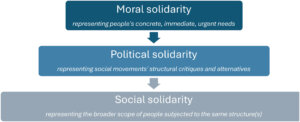
Representing suffering in solidarity begins with impacted people’s most urgent needs – in their own words. This means passing the mic to people who are suffering so that they have a chance to speak first for their collective survival, before moving on to represent larger social movements and global structures. Solidarity reporting prioritizes what people who are suffering know and know they need to survive.
This resource is based on the following scholarship. If you would like a PDF of these works, please email anita.varma@austin.utexas.edu.
Varma, A. (2025). A Solidarity Framework for Representing Suffering: Resisting a Desensitizing Status Quo of Normalizing Social Injustice. Journal of Communication Inquiry.
Ibrahim, O. & Varma, A. (2024). “Reinforcing Climate Colonialism or Advancing Climate Justice? A Critical Analysis of Cyclone Freddy News Coverage.” Accepted to the 75th Annual International Communication Association conference, Denver, Colorado. Journalism Studies Division.